Quantum error correction and the torsor-cocycle
correspondence
Ben McDonough
6-22-26
Introduction
A fundamental result in algebraic topology is the monodromy theorem, which says that the Betti moduli space \(\operatorname{Hom}(\pi_1(X), G)/G\) classifies \(G\)-principal bundles (when \(G\) is a discrete group). The Reimann-Hilbert correspondence also establishes a connection between monodromy representations and flat connections. This correspondence is particularly apparent in quantum double codes—discretizations of non-anomalous TQFTs with a finite gauge group—where it is easy to show explicitly the correspondence between codewords and monodromy representations [1], [2].
We will explain the monodromy theorem through the correspondence between torsors and Čech cocycles [3], and then see how this correspondence is a new and beautiful way to view the codewords of a quantum double model.
Torsors, principal bundles, and Čech cohomology
Def 1. Let \(G\) be a discrete group, and let \(\mathcal G(G)\) be the sheaf of continuous functions \(G \to X\).
Def 2. If \(\mathcal G\) is a sheaf of groups, then a \(\mathcal G\)-torsor is a sheaf \(\mathcal F\) with nonempty stalks equipped with a free and transitive action \(\mathcal G(U) \times \mathcal F(U) \to \mathcal F(U)\).
Def 3. Given an open cover \(\mathfrak U\) indexed by a totally ordered set \(I\) and a sheaf \(\mathcal F\) of groups, the Cech cocycles of \(\mathfrak U\) with coefficients in \(\mathcal F\) are defined as \[\begin{aligned} C^0(\mathfrak U, \mathcal F) &\equiv \prod_{i}\mathcal F(U_i) & C^1(\mathfrak U, \mathcal F) & \equiv \prod_{i < j}\mathcal F(U_i \cap U_j) & C^2(\mathfrak U, \mathcal F) &\equiv \prod_{i < j < k}\mathcal F(U_i \cap U_j \cap U_k) \end{aligned}\] With the coboundary maps \[\begin{aligned} d^0 : f \in \mathcal F(U) &\mapsto (f|_{U_i})_{i \in I} & d^1:(f_i)_{i \in I} &\mapsto (f_i|_{U_j}f_j|_{U_i}^{-1})_{i < j} & d^2: (f_{ij})_{i < j} &\mapsto (f_{ij}|_{U_k} f_{jk}|_{U_i}f_{ik}|_{U_k}^{-1})_{i < j < k} \end{aligned}\] creating a chain complex \[\begin{aligned} \mathcal F(X) \xrightarrow{d} C^0(\mathfrak U, \mathcal F) \xrightarrow{d} C^1(\mathfrak U, \mathcal F) \xrightarrow{d} C^2(\mathfrak U, \mathcal F) \end{aligned}\] which defines the Cech cohomology of \(\mathfrak U\) with coefficients in \(\mathcal F\). To obtain the Cech cohomology of \(X\) with coefficients in \(\mathcal F\), the direct limit is taken over \(\mathfrak U\) with respect to refinement. Thus, \[\begin{aligned} H^i(X, \mathcal F) \equiv \{[(\mathfrak U, f)]\} : (\mathfrak U, f) \sim (\mathfrak V, g) \text{ if $\mathfrak U$ and $\mathfrak V$ have a common refinement in which $f,g$ agree.} \end{aligned}\]
Def 4. A \(G\)-covering space is a cover \(\pi:E \to X\) with an action of \(G\) by homeomorphisms which (1) acts on the fibers, i.e. \(\pi \circ g = \pi\), and (2) the action of \(G\) on \(\pi^{-1}(x)\) is free and transitive. From this definition, it is apparent that \(\mathcal G(G)\)-torsors correspond to both \(G\)-covering spaces and \(G\)-principal bundles when \(G\) is discrete. The covering is called \(\mathfrak U\)-based if \(\mathfrak U\) locally trivializes the cover.
Torsor-cocycle correspondence
Prop 1. A Cech cohomology class \(g_{ij} \in H^1(\mathfrak U, \mathcal G)\) can be constructed from a \(\mathfrak U\)-based \(G\)-covering space.
Proof. For each \(U_i\), choose a local section \(s_i: U_i \to \pi^{-1}(U_i)\). By the transitivity of the \(G\)-action, for any \(U_i,U_j\) there function \(g_{ij}:U_i \cap U_j \to G\) such that \[\begin{aligned} s_i|_{U_j} = g_{ij}s_j|_{U_i} \end{aligned}\] which defines a transition function. (Note that \(g_{ij}\) is constant on connected components of \(U_i \cap U_j\) because \(G\) is discrete. If all intersections \(U_i \cap U_j\) are connected, then \(g_{ij}(x) = g_{ij}\) is a constant.) Then \[\begin{aligned} s_{i}|_{U_j \cap U_k} = g_{ij}s_j|_{U_i \cap U_k} = g_{ij}g_{jk}s_k|_{U_i \cap U_j} = g_{ij}g_{jk}g_{ik}^{-1}s_i|_{U_j \cap U_k} \end{aligned}\] by the freeness of the action, this implies \[\begin{aligned} (g_{ij})_{i < j} \in C^1(\mathfrak U, \mathcal G) \end{aligned}\] The choice of section was arbitrary, so we need to confirm that the cohomology class does not depend on the choice of section. Suppose we had instead chosen another set of local sections \(s'_i\). By the transitivity of the \(G\)-action, we have \(s'_i = h_i s_i\) for some \(h_i :U_i \cap U_j \to U_i \to G\). Then \[\begin{aligned} s_i'|_{U_j} = h_i s_i|_{U_j} = h_i g_{ij} s_j|_{U_i} = h_i g_{ij} h_j^{-1} s_{j}|_{U_j}' \end{aligned}\] so again by freeness of the action, we find \[\begin{aligned} g_{ij}' = h_i g_{ij} h_j^{-1} \end{aligned}\] So the cocycles \((g_{ij})_{i < j}\) and \((g_{ij}')_{i < j}\) differ by a coboundary \((h_i)_{i \in I} \in B^0(\mathfrak U, \mathcal G)\). ◻
Prop 2. A Cech cocycle can be used to specify the transition functions of a \(G\)-covering space. Furthermore, a cohomology class specifies an isomorphism class of \(G\)-covering spaces.
Proof. Let \((g_{ij})_{i < j} \in C^1(\mathfrak U, \mathcal G)\), and consider the space \[\begin{aligned} X_g \equiv \prod_{i} U_i \times G / \sim \end{aligned}\] where the equivalence relation is \[\begin{aligned} (u_i, g) \sim (u_j, h) \text{ if } u_j, u_i \in U_i\cap U_j \text{ and $h(u_j) = g_{ij}(u_i)g(u_i)$}. \end{aligned}\] We have literally taken the stack of pancakes above each open set and glued them together according to the given transition functions. The transitivity and reflexivity of this relation follow from the cocycle condition.
Furthermore, if \(\mathfrak U\) is a normal cover of the space, then we can show that every \(G\)-cover is isomorphic to a cover of this form. Let \(\pi : E \to X\) be a \(G\)-cover. Then \[\begin{aligned} E \cong \prod_{i}\pi^{-1}(U_i) / \sim \end{aligned}\] where this time \(\sim\) is just equality in \(E\). We have \(\pi^{-1}(U_i) \sim U_i \times G\) because the cover is normal, but this identification is non-canonical. This identification is equivalent to a choice of section \(s_i : U_i \to \pi^{-1}(U_i)\) to identify with \(U_i \times \{1_G\}\). The action of \(G\) is free and transitive, so \(s_i = g_{ij}s_j\) for some \(g_{ij} \in G\), which defines the transition functions.
A change of sections to \(s_i'\) corresponds to permuting the stack of pancakes in each \(\pi^{-1}(U_i)\), so \(s_i' = f_i s_i\), and therefore \(g_{ij}' = f_i g_{ij}f_{j}^{-1}\). This identifies each cover not with a particular cocycle, but with a cohomology class. An isomorphism of covers \(\pi : E \to E'\) has a set of sections \(\psi(s_i)\), which is similarly related to the sections \(s_i'\) of \(E'\) by \(\psi(s_i) = f_i s_i'\). Therefore cohomology classes are in correspondence with isomorphism classes of \(G\)-covers. ◻
The monodromy theorem
Prop 3. Suppose that \(X\) is connected and semilocally simply connected. Then an element of the Betti moduli space specifies a Čech cohomology class.
Proof. Choose a basepoint \(x_0\). Let \[\begin{aligned} \psi \in \operatorname{Hom}(\pi_1(X, x_0), G) \text{ represent } [\psi] \in \operatorname{Hom}(\pi_1(X, x_0), G)/G \end{aligned}\] Let \(\mathcal U = \{U_i\}\) be an open cover such that the fundamental group of each open set includes trivially into the fundamental group of \(X\). Associate a point \(x_i \in U_i\) for each \(i\), and a basepoint \(x_0 \in U_0\). For each \(i\), let \(\gamma_i\) be a selected path from \(x_0\) to \(x_i\). Given \(x \in U_i \cap U_j\), Define a path \(\alpha_i(x) : x_i \to x\) contained in \(U_i\) and \(\alpha_j(x) : x_j \to x\) contained in \(U_j\). Then the transition function \(g_{ij}:U_i \cap U_j \to G\) will be defined by \[\begin{aligned} g_{ij}(x) = \psi([\gamma_i * \alpha_i(x) * \overline \alpha_j(x) * \overline \gamma_j]) \end{aligned}\] First, we need to verify the cocycle condition: \[\begin{aligned} g_{ij} g_{jk}g_{ik}^{-1} &= \psi([\gamma_i * \alpha_i(x) * \overline \alpha_j(x) * \overline \gamma_j]) \psi([\gamma_j * \alpha_j(x) * \overline \alpha_k(x) * \overline \gamma_j]) \psi([\gamma_k * \alpha_k(x) * \overline \alpha_i(x) * \overline \gamma_i]) \\ &= \psi([\gamma_i * \alpha_i(x) * \overline \alpha_j(x) * \alpha_j(x) * \overline \alpha_k(x) * \alpha_k(x) * \overline \alpha_i(x) * \overline \gamma_i]) = 1 \end{aligned}\] Clearly, this is just the constant path. Now, we need to verify well-definedness, or in other words, check that the choices of points \(x_i\) (including the basepoint) and families of paths \(\alpha_i(x)\) did not determine the mapping. First, since \(\pi_1(U_i) \hookrightarrow \pi_1(X)\) trivially, clearly the choice of \(\alpha_i\) did not matter. Similarly, the choice of \(x_i\) does not change the homotopy class of any of the paths. However, the choice of \(\gamma_i\) may have a nontrivial effect, because perhaps \(\gamma_i\) could wind around a hole in \(X\). If we have another set of paths \(\gamma_i'\), then the new transition functions are \[\begin{aligned} g_{ij}'(x) &= \psi([\gamma_i' * \alpha_i(x) * \overline \alpha_j(x) * \overline \gamma_j']) \\ &= \psi([\gamma_i' * \overline \gamma_i * \gamma_i * \alpha_i(x) * \overline \alpha_j(x) * \overline \gamma_j * \gamma_j * \overline \gamma_j']) \\ &= \psi([\gamma_i' * \overline \gamma_i])\psi([\gamma_i * \alpha_i(x) * \overline \alpha_j(x) * \overline \gamma_j])\psi([\gamma_j * \overline \gamma_j']) \end{aligned}\] Therefore the cocycle is unique up to the coboundary \(f_i \equiv \psi([\gamma_i' * \overline \gamma_i])\). Lastly, if \(\psi'\) is another representative of \(\psi\), then \(\psi' = g\psi g^{-1}\) for some \(G\), so the cocycle is again determined up to a coboundary. The same is true if the basepoint \(x_0\) is changed.
Lastly, we can see that the mapping was independent of the choice of open cover, precisely because of the semilocally simply connected condition. This property is stable under refinement, so this set of covers is cofinal, and therefore we can pass to the direct limit. ◻
Prop 4. Every Cech cohomology class is associated to a monodromy representation.
Proof. Take an open cover \(\mathfrak U\) which satisfies the semilocal simply connected condition and a Cech cocycle \((g_{ij})_{i < j}\). For a given loop \(\gamma\), we will take a Lebesgue partition \([0,1] = \bigcup_i[t_i, t_{i+1}]\) such that \(\gamma([t_i, t_{i+1}]) \subset U_i\). Then we put \[\begin{aligned} \psi([\gamma]) \equiv \prod_{i} g_{i,i+1}(\gamma(t_{i+1})) \end{aligned}\] Since \(\mathcal G\) is a sheaf of locally constant functions, we can choose a refinement of \(\mathfrak U\) such that \(g_{i, i+1}\) is constant on \(U_i\), and thus the map is independent of the particular Lebesgue partition. To prove that the map is independent of the cover, consider a refinement of \(\mathfrak U\) such that \(t_i, t_{i'} \in U_{i'}\) and \(t_{i'}, t_{i+1} \in U_{i+1}\). Then by the cocycle condition, since \(\gamma(t_{i'}) \in U_{i}\cap U_{i'} \cap U_{i+1}\), we have \(g_{i, i'} g_{i',i+1} = g_{i, i+1}\), so the mapping is unchanged. Then given any two covers, we can pass to a common refinement. To prove homotopy invariance, we consider that the map is unchanged under any small perturbation to the path since the sections of \(\mathcal G\) are locally constant. ◻
Quantum double codewords as Čech cocycles
Def 5. Given a triangulation of an orientable manifold \(M\), let \(\epsilon_v(e)\) denote the orientation of an edge with respect to a vertex (incoming or outgoing) and \(\epsilon_p(e)\) denote the orientation of an edge with respect to a plaquette. Let \(S^X\) denote the group of gauge transformations, which is generated by the operators \[\begin{aligned} A_v(g) \equiv \prod_{e \ni v}X_e^{\epsilon_v(e)}(g^{-1}) \end{aligned}\] where \(X_e^{\pm 1}(g)\) acts on edge \(e\) by left(right) multiplication by \(g\). Then the associated quantum double codewords are given by \[\begin{aligned} \prod_v \sum_{g \in G}A_v(g)\ket{\vb g_L} = \sum_{\vb g \in G^{|V|}}A_v(g_v)\ket{\vb g_L} \end{aligned}\] and \(\ket{\vb g_L}\) is any flux-free state, i.e one that satisfies \[\begin{aligned} \overrightarrow\prod_{e \in \partial p} (\vb g_L)_v^{\epsilon_{p}(e)} = 1_G \end{aligned}\] Thus each codeword can be represented by a class \([\vb g_L] \in G^{|E|}/\mathcal X\) corresponding to a set of states \[\begin{aligned} \left\{\prod_vA_v(g_v)\ket{\vb g_L}\right\}_{\vb g \in G^{|V|}} \end{aligned}\] in the same equivalence class.
We will recap the proof quickly:
Prop 5. The QD codewords correspond to elements of the Betti moduli space.
Proof. Fix a basepoint \(x_0\). Given any codeword \(\vb g_L\), taking the holonomy around any loop gives a map \(\vb g_L \mapsto \psi \in \operatorname{Hom}(\pi_1(M), G)\). The map \(\psi\) is well-defined on homotopy classes of loops because of the flux-free condition. \(A_{v}\) commutes with the holonomy operator unless \(v = x_0\), and the effect of \(A_{x_0}(g)\) is \(\psi \mapsto g^{-1}\psi g\), so this map is well-defined on equivalence classes of states.
For the other direction, fix a spanning tree \(T\). Given \([\psi] \in \operatorname{Hom}(\pi_1(M), G)/G\), take a representative \(\psi\), and construct a logical representative \(\ket{\vb g_L}\) by decorating each edge \(e\) outside of \(T\) with \(\psi(\gamma_e)\), where \(\gamma_e\) is a loop through the basepoint passing through \(e\). The flux-free condition on \(\ket{\vb g_L}\) is ensured by the fact that \(\psi\) is constant on homotopy classes of loops. Taking the orbit under \(S^X\) leaves holonomies unchanged, except for \(A_{x_0}(g) \in S^X\) which conjugates them by \(g\), equivalent to choosing another representative of \(\psi\). These two maps are mutually inverse. ◻
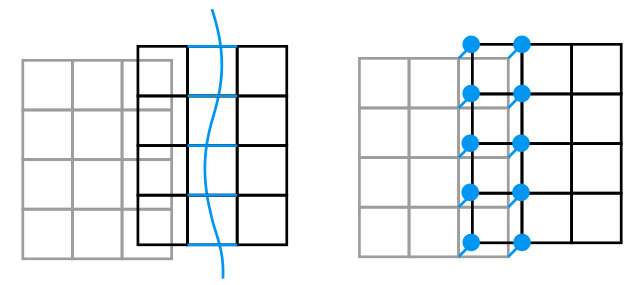
What is less obvious, then, is that we can construct a Čech cocycle from a codeword. The idea is very general: every codeword is locally a product of stabilizers because the code has a large distance. The difference in this local representation on overlapping neighborhoods gives the transition functions of a principal bundle. This idea is illustrated in Fig. 1.
Prop 6. Every codeword of a quantum double corresponds uniquely to a Čech cohomology class.
Proof. Consider a codeword \[\begin{aligned} \left \{\prod_v A_v(g_v)\ket{\vb g_L}\right \}_{\vb g \in G^{|V|}} \end{aligned}\] with a chosen representative \(\vb g_L\). Let \(\mathfrak U = \{U_i\}_{i \in I}\) be a good open cover, i.e. where the sets \(U_i\) are contractible. Consider \(A\) as an opposite morphism, i.e. \[\begin{aligned} A(\vb g) &\equiv \prod_{v} A_v(g_v) & A(\vb g \vb h) &= A(\vb h)A(\vb g) \end{aligned}\] This will be a helpful convention to respect path ordering. Then we can define a restriction map on states \[\begin{aligned} \ket{\vb g}|_{U_i} \equiv \bigotimes_{v \in U_i}\ket{g_v}_v \end{aligned}\] Because \(U_i\) are contractible, this means that there is a unique codeword on each \(U_i\), and thus \[\begin{aligned} \ket{\vb g_L}|_{U_i} = A(\vb g_i)\ket{0}|_{U_i} \end{aligned}\] for a particular \(\vb g_i \in G^{|U_i|}\). This representative is unique up to \[\begin{aligned} \ket{\vb g_L}|_{U_i} = A(\vb g_i)\ket{0}|_{U_i} = A(\vb g_i)\prod_{v \in U_i}A_v(g)\ket{0}|_{U_i} = A(g\vb g_i)\ket{0}|_{U_i} \end{aligned}\] for each \(g \in G\), corresponding to \(\vb g_i \mapsto g\vb g_i\). The choices of how to represent \(\vb g_L\) as a product of stabilizers define the different sheets of the \(G\)-cover. The free and transitive action of \(G\) on these sheets is by left translation: \(\vb g_i \mapsto g\vb g_i\). The choice of a particular representative \(\vb g_i\) corresponds to a choice of section of the covering map for each \(U_i\).
Now we will define the transition maps \[\begin{aligned} \vb g_{ij} = \vb g_i\vb g_j^{-1}|_{U_i \cap U_j} \end{aligned}\] associated to any intersection \(U_i \cap U_j\). First, we need to show that \(\vb g_{ij} = g_{ij}\) is constant. Importantly, \(\vb g_i\) and \(\vb g_j\) will not be constant on all of \(U_i\) and \(U_j\), otherwise the transition maps would simply be coboundaries. Since \[\begin{aligned} A(\vb g_i)\ket{0}|_{U_i\cap U_j} = A(\vb g_j)\ket{0}|_{U_j\cap U_i} \end{aligned}\] This means that \[\begin{aligned} A(\vb g_j^{-1})A(\vb g_i)\ket{0}|_{U_i\cap U_j} = A(\vb g_i \vb g_j^{-1})\ket{0}|_{U_i \cap U_j} = A(\vb g_{ij})\ket{0}|_{U_i \cap U_j} = \ket{0}|_{U_i \cap U_j} \end{aligned}\] and since the only stabilizer redundancy is global multiplication (i.e. the kernel of \(A\) is the diagonal subgroup of \(G^{V}\)), we see that \(\vb g_{ij}\) is a member of the diagonal subgroup. The cocycle condition follows automatically from the definition, because \[\begin{aligned} g_{ij}g_{jk}g_{ik}^{-1} = \vb g_i \vb g_j^{-1} \vb g_j \vb g_k^{-1} \vb g_k \vb g_i^{-1}|_{U_i \cap U_j \cap U_k} = 1 \end{aligned}\] We can see that another choice of sections \(\{\vb g_i\} \mapsto \{f_i \vb g_i\}\) adjusts the transition functions by a coboundary.
Lastly, if we choose a different representative \(\ket{\vb g_L'} = A(\vb h)\ket{\vb g_L}\), then \[\begin{aligned} \ket{\vb g_L'}|_{U_i} = A(\vb h)\ket{\vb g_L}|_{U_i} = A(\vb h)A(\vb g_i)\ket{0}|_{U_i} = A(\vb g_i \vb h)\ket{0}|_{U_i} \end{aligned}\] thus the transition functions are unchanged: \[\begin{aligned} g_{ij}' = \vb g_i \vb h_i (\vb g_j\vb h)^{-1} = \vb g_i \vb h_i \vb h_j^{-1} \vb g_j^{-1} = \vb g_i \vb g_j^{-1} = g_{ij} \end{aligned}\] This shows that each codeword is associated to a Cech cocycle \(g_{ij} \in H(\mathcal U, \mathcal G)\), and clearly, this association is stable under refinement of the cover.
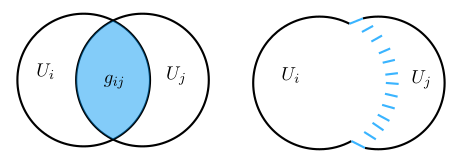
In order to complete the correspondence, suppose we have a good cover \(\mathfrak U\) (this is fine since good covers are cofinal) and a Cech cocycle \(g_{ij} \in H(\mathfrak U, \mathcal G)\). Put a total ordering on the set \(I\). First, we construct \(\vb g_i\) inductively by assuming that \(\vb g_j\) have already been constructed for \(j < i\). Then if \(U_i\) intersects with \(U_j\) for any \(j < i\), we define \[\begin{aligned} \vb g_i|_{U_i \cap U_j} = g_{ij}\vb g_j \end{aligned}\] with \(\vb g_j = 1\) elsewhere. Because of the triple intersection condition, \(\vb g_{i}\) is well-defined. Next, put \[\begin{aligned} \ket{\vb g_L}|_{U_i} \equiv A(\vb g_i)\ket{0}|_{U_i} \end{aligned}\] this does not literally represent \(\ket{\vb g_L}\) as a product of stabilizers because the restriction map deletes edges from \(A(\vb g_i)\) on the boundary of \(U_i\). An example is shown in Fig. 2.
To prove that this state is well-defined, we must ensure that it agrees on overlaps. We see that \[\begin{aligned} A(\vb g_i)\ket{0}|_{U_i \cap U_j} = A(g_{ij}\vb g_j)\ket{0}|_{U_i \cap U_j} = A(\vb g_j) \ket{0}|_{U_i \cap U_j} \end{aligned}\] because \(A(g_{ij})\ket{0} = \ket{0}\). Thus this map is an inverse to the previous one, which identifies codewords with Cech cocycles. ◻